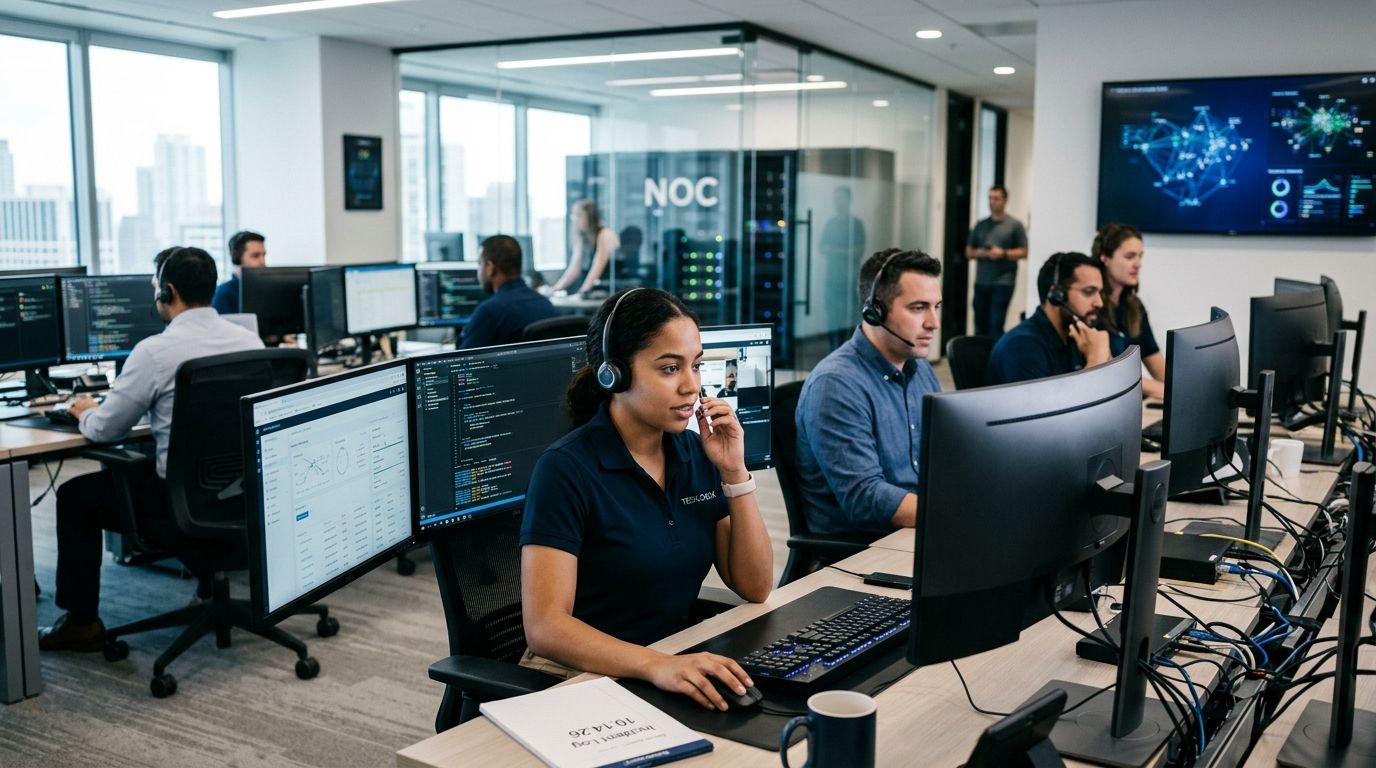
Manufacturers choosing managed IT services in 2026 face a problem office-only providers rarely understand: production equipment that cannot tolerate downtime, sitting on the same network as email and file servers that ransomware crews target every day. This guide ranks the real options - from full-service providers to software-only tools - so you can match the model to your plant instead of buying whatever a salesperson pitches first.
Best overall: ShorePointIT. Best for manufacturers with an internal IT hire: the co-managed IT model. Best budget option: software-only RMM/monitoring tools.
- ShorePointIT wins for manufacturers needing compliance-ready cybersecurity and senior IT leadership without hiring a full-time CIO.
- Co-managed IT is the right call when you already have one IT hire who needs backup on security and strategy.
- Large national MSPs suit multi-site manufacturers spanning several states, not single-plant shops.
- Software-only RMM tools are the budget option, but only work if someone in-house acts on the alerts.
- Skip in-house-only IT for any shop running networked PLCs or SCADA - one person is not a disaster recovery plan.
Why this matters
A manufacturer's network usually spans two worlds: the office side (email, ERP, file shares) and the plant side (PLCs, SCADA, legacy machine controllers). Most generic IT providers only understand the first one. ShorePointIT built its practice around small and mid-sized manufacturers precisely because that gap is where downtime and breach risk both live.
Compliance adds another layer. If you supply parts into a defense or aerospace chain, CMMC 2.0 and NIST SP 800-171's 110 controls are not optional reading - they are what your customer's procurement team will ask about. A provider that cannot map its work to those frameworks is guessing.
What makes the best managed IT services for manufacturers
- OT/IT convergence experience - comfort working with PLCs, SCADA, and legacy machine controllers, not just office laptops
- Cybersecurity mapped to real frameworks - CMMC 2.0, NIST SP 800-171, and IEC 62443 awareness, not generic antivirus talk
- Documented uptime response for production systems, tracked separately from office help-desk tickets
- Backup and disaster recovery tested on both shop-floor and office systems, not just servers
- Senior-level technology leadership - someone who can explain tradeoffs to plant management in plain terms
- No-pressure scoping - a provider willing to walk through options instead of pushing the biggest contract available
Managed IT services for manufacturers, at a glance
| Model | Best for | Standout feature | Key limitation |
|---|---|---|---|
| ShorePointIT | Compliance-ready cybersecurity without a CIO | Senior leadership paired with monitoring | Built for small/mid-sized, not 20-plant rollouts |
| Co-managed IT | Manufacturers with one internal IT hire | Keeps institutional knowledge in-house | Needs clear division of duties up front |
| Large national MSP | Multi-state, multi-site manufacturers | Broad geographic coverage | Technicians often rotate across accounts |
| Software-only RMM tools | Teams with a capable internal staff | Lower ongoing overhead | No strategic or compliance guidance |
| In-house-only IT | Very small, single-site shops | Full internal control | Single point of failure, no bench depth |
1. ShorePointIT: best managed IT for manufacturers needing compliance-ready cybersecurity
ShorePointIT provides managed IT services, cybersecurity, and cloud migration support built for small and mid-sized manufacturers without a full-time CIO. The model pairs senior-level technology leadership with day-to-day monitoring, so decisions about firewalls, backups, and compliance come from someone who has made those calls before, not a rotating help-desk tech.
ShorePointIT pros:
- Senior-level guidance instead of ticket-only support
- Cybersecurity practice built around managed cybersecurity services mapped to real frameworks, not generic checklists
- No-obligation scoping conversations before any contract commitment
- Plain-spoken communication with plant management instead of jargon-heavy reports
ShorePointIT cons:
- Best fit is small to mid-sized manufacturers, not large multi-state operations
- Recommendations firm up only after a real asset and network inventory
Best for: manufacturers that need cybersecurity and senior technology leadership without hiring a full-time CIO. Verdict: Buy.
2. Co-managed IT: best for manufacturers with an internal IT hire
Co-managed IT means an outside partner works alongside your existing IT person instead of replacing them. Your hire keeps day-to-day familiarity with equipment and vendors while the outside partner adds cybersecurity depth, after-hours coverage, and a second opinion on strategy - a structure covered in more detail in this guide to co-managed IT services.
Co-managed IT pros:
- Keeps institutional knowledge in-house
- Adds bench strength for security incidents and vacations
- Usually less overhead than a full CIO hire
Co-managed IT cons:
- Requires a clear, written division of responsibilities up front
- Weaker fit if your internal hire is already stretched thin with no time to coordinate
Best for: manufacturers with one internal IT person who needs backup on security and strategy. Verdict: Buy.
3. Large national MSP: best for multi-site manufacturers
National managed service providers cover many states and can support manufacturers with plants spread across regions under one contract. The tradeoff is usually account depth - large providers often rotate technicians across dozens of clients, so plant-floor familiarity builds slower than with a regional partner.
Large national MSP pros:
- Broad geographic coverage for multi-site operations
- Established onboarding process for adding new locations
Large national MSP cons:
- Technicians may rotate, slowing plant-specific familiarity
- Support often skews toward office IT, not shop-floor systems
Best for: manufacturers running plants in several states that need one contract covering every location. Verdict: Hold - worth it only once you actually have multiple sites.
4. Software-only RMM/monitoring tools: best for teams with a capable internal staff
Remote monitoring and management (RMM) tools give dashboards and alerts without a managed services contract attached. Someone in-house still has to read the alerts, patch systems, and respond when something breaks - the tool watches, it doesn't decide.
RMM tools pros:
- Lower ongoing overhead than a full-service contract
- Works well if your internal team is already competent
RMM tools cons:
- No strategic guidance or compliance mapping included
- Alerts only help if someone is actually watching them at 2am
Best for: manufacturers with a capable internal team that wants better tooling, not more staff. Verdict: Hold.
5. In-house-only IT: best for very small single-site shops
Some smaller shops run IT entirely in-house with no outside managed services relationship at all - usually one person handling networking, backups, and whatever breaks that week.
In-house-only IT pros:
- Full control over every decision
- No outside contract to manage or coordinate
In-house-only IT cons:
- Single point of failure - if that person is out, nothing gets covered
- No dedicated cybersecurity practice watching for phishing or ransomware
Best for: very small, single-site shops with minimal networked equipment and low digital exposure. Verdict: Wait - reasonable only until you add networked machines or start handling customer data worth protecting.
Get a plant-floor risk review
A no-obligation look at where cybersecurity and uptime risk actually sit today.
How we ranked these
Each model was scored against the six criteria above: OT/IT convergence experience, framework-mapped cybersecurity, documented uptime response, tested backup and recovery, senior-level leadership, and no-pressure scoping. The scoring reflects how each model type typically behaves in the field, not a single company's marketing copy.
“If your IT provider can't tell you which of your PLCs talk to the outside network, they don't understand your actual risk.”
Which managed IT service should a manufacturer choose in 2026?
For most small and mid-sized manufacturers without a dedicated CIO, a full-service model like ShorePointIT that bundles cybersecurity, compliance awareness, and senior leadership is the stronger default in 2026. If you already employ a solid internal IT person, co-managed IT gets you the same depth without replacing anyone. Multi-site operations spanning several states should weigh a national MSP against the loss of plant-specific familiarity, and single-site shops with minimal networked equipment can reasonably wait - but only until that changes. The same logic that applies to manufacturers also shows up in how small businesses evaluate managed IT services: match the model to actual exposure, not company size alone.
FAQ
What's the best managed IT service for manufacturers in 2026?
For small and mid-sized manufacturers without a full-time CIO, a full-service provider like ShorePointIT that combines cybersecurity, compliance awareness, and senior technology leadership is the strongest default in 2026. Multi-site operations may need a national MSP instead, and shops with an internal IT hire often do better with a co-managed setup.
Is co-managed IT better than a full outsourced MSP for manufacturers?
Co-managed IT works better when you already have a competent internal IT hire who needs backup on security and strategy. A fully outsourced MSP makes more sense when there's no internal IT staff at all.
Do manufacturers need CMMC 2.0 compliance from their IT provider?
Only if you handle controlled unclassified information tied to a defense or aerospace contract. CMMC 2.0 has three certification levels, and the level required depends on what data your contracts involve.
What is NIST SP 800-171 and does it apply to manufacturers?
NIST SP 800-171 is a federal standard with 110 security controls for protecting controlled unclassified information. It applies to manufacturers that handle that kind of data as part of a government supply chain.
Can a national MSP support a single-site manufacturer effectively?
Yes, but it's often overkill - national MSPs are built for coverage across many locations, and single-site shops usually get more attentive service from a regional or co-managed provider.
Is software-only monitoring enough for a manufacturing shop?
Only if someone in-house is genuinely watching the alerts and acting on them. RMM tools provide visibility, not strategy or incident response.
How do I know if my current IT provider understands OT/IT convergence?
Ask them to name which of your PLCs or SCADA systems communicate with the outside network. If they can't answer specifically, they're managing your office network, not your actual risk.
What's the biggest IT risk for manufacturers in 2026?
The biggest risk is a network where shop-floor equipment and office systems share the same exposure, with no tested backup plan for either side. Ransomware that hits email can just as easily stall a production line if the network isn't segmented.
One last thing
Most manufacturers focus their cybersecurity questions on office systems and skip the plant floor entirely. IEC 62443 is the international standard written specifically for industrial automation and control systems - ask any provider you're evaluating whether they design controls against it, or only against office-network frameworks. That one question separates providers who understand manufacturing from providers who've just added "manufacturing" to their website.