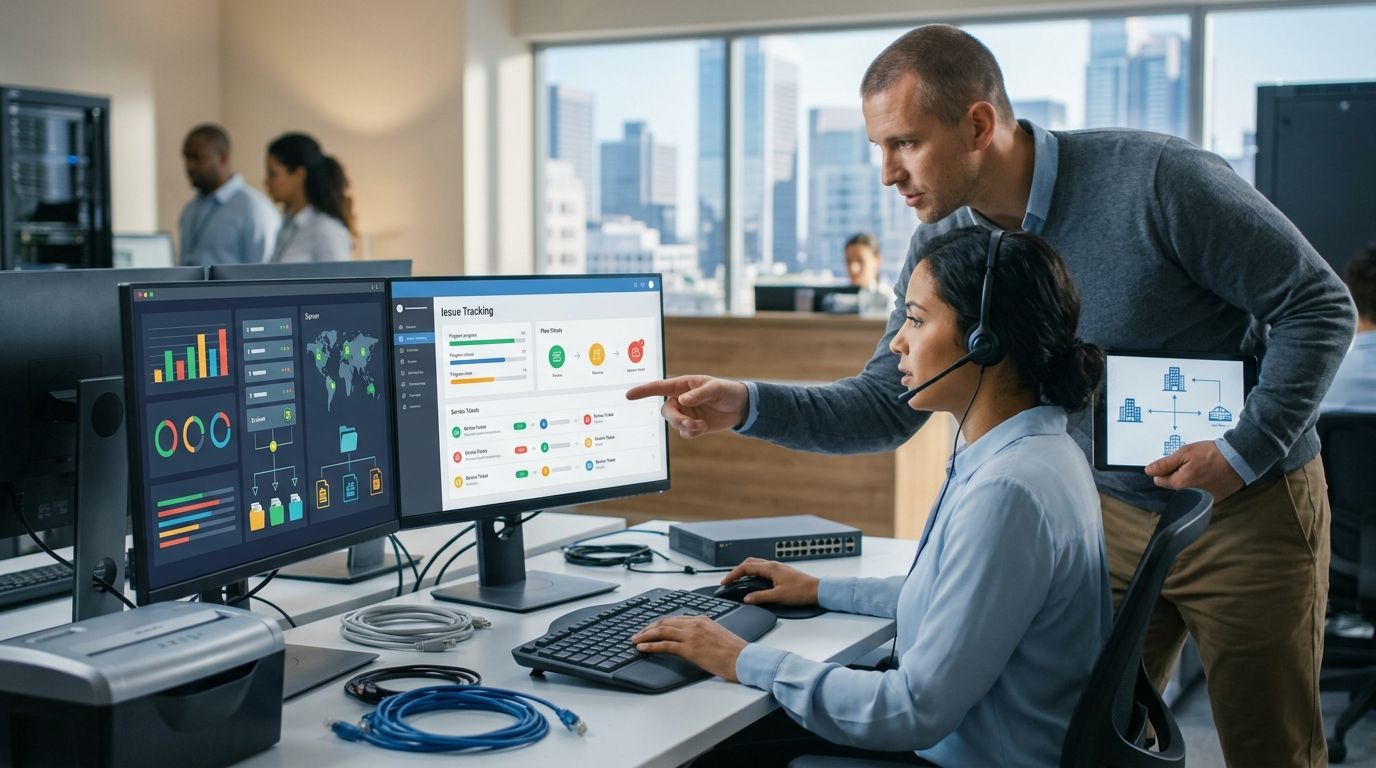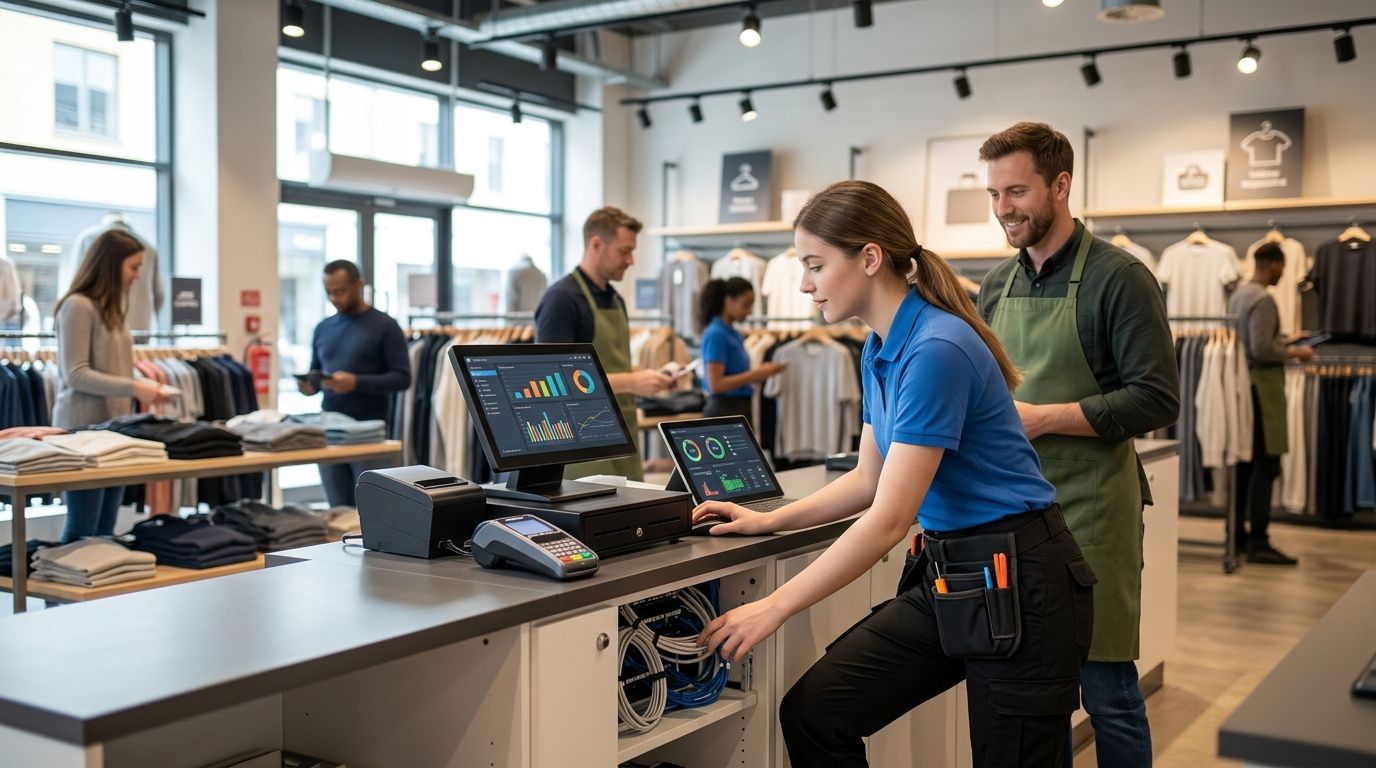
Retail chains run on point-of-sale uptime, PCI DSS compliance, and a network that doesn't buckle during a Saturday rush across a dozen storefronts. Picking it support for retail chains in 2026 means choosing the model that fits how many locations you run and how tightly regulated your payment data is — not just who answers the phone fastest.
- Retail-specialized managed IT providers, including ShorePointIT, fit it support for retail chains with 3+ locations and PCI DSS obligations best.
- National break-fix vendors repair hardware well but rarely manage compliance, network design, or multi-site consistency.
- Co-managed IT works when a chain already has one in-house IT hire who needs backup, not a replacement.
- Offshore helpdesk-only providers handle high-volume basic tickets well but are weakest on escalation speed and strategic planning.
- PCI DSS v4.0 requirements are fully in effect as of 2026 — ask any provider for your current compliance status before signing.
Why this matters
A single-location retailer can survive a slow ticket response. A retail chain can't — a POS outage at one store during a holiday weekend costs sales at that register every minute it's down, and a network misconfiguration at one location often means the same mistake exists at every other location too.
Retail chains also carry PCI DSS obligations that a law firm or contractor doesn't. PCI DSS v4.0 requirements became fully mandatory by March 31, 2025, and by 2026 most acquirers and processors expect chains to already be compliant, not working toward it. If your current IT support can't tell you where you stand against v4.0 today, that gap is worth fixing before you renew.
The providers below aren't ranked by brand — they're ranked by model, because the model determines what you actually get.
What makes the best IT support for retail chains
- Multi-site network standardization — the same firewall rules, WiFi setup, and vendor configs at every store, not a patchwork built store by store.
- POS and payment uptime with defined response times — a written commitment for how fast a down register gets a technician, not a general helpdesk queue.
- PCI DSS compliance support — someone who can document scope, segmentation, and current status against PCI DSS v4.0, not just install antivirus.
- After-hours and weekend escalation — retail runs weekends and holidays; IT support that only works 9-to-5 weekdays doesn't match the business.
- Vendor management — one point of contact who deals with your POS vendor, ISP, and payment processor instead of you juggling three support lines during an outage.
- Scalability for new store openings — a process for standing up network, POS, and WiFi at a new location without reinventing it each time.
IT support for retail chains: at a glance
| Provider type | Best for | Standout feature | Key limitation |
|---|---|---|---|
| Retail-specialized managed IT provider (ShorePointIT) | Multi-location chains with PCI DSS needs | POS, network, and compliance managed under one team | More structure than a single-store retailer typically needs |
| National break-fix vendor | On-site hardware repair only | Wide field-technician coverage across regions | No compliance guidance or long-term IT strategy |
| Offshore helpdesk-only provider | High-volume, low-complexity tickets | 24/7 phone coverage for resets and basic requests | Escalation speed and follow-through vary by shift |
| Co-managed IT arrangement | Chains with one in-house IT hire | Backs up existing staff without replacing them | Needs clear division of duties to avoid dropped tickets |
| Regional generalist MSP | Single-region chains, simpler footprint | Local knowledge of regional vendors and ISPs | Rarely built for multi-state PCI DSS complexity |
1. Retail-specialized managed IT providers: best IT support for retail chains with PCI DSS and multi-site needs
This model combines a managed helpdesk, network standardization across locations, and compliance documentation under one team — the same structure ShorePointIT uses for multi-site clients in regulated industries. It's built for chains that can't afford inconsistent setups store to store.
Retail-specialized MSP pros:
- One team accountable for network, POS support, and PCI DSS documentation
- Consistent configuration rolled out the same way at every store
- A senior technology advisor available for planning, not just tickets
- Vendor management so you're not the one on hold with your POS company
Retail-specialized MSP cons:
- More structure and process than a single-location retailer usually needs
- Onboarding takes longer because it requires documenting every store's setup
Best for: chains with three or more locations, active PCI DSS obligations, or plans to open new stores in 2026. Verdict: Buy if you run more than one location and handle card payments — this is the model built for exactly that problem.
2. National break-fix vendors: best IT support for retail chains that only need hardware repair
These vendors dispatch field technicians to fix broken hardware — a dead register, a failed switch, a printer that won't connect. They're transactional by design: you call, someone shows up, the ticket closes.
National break-fix vendor pros:
- Broad geographic coverage if you have stores in many states
- No long-term contract required for one-off repairs
- Fast for simple, isolated hardware problems
National break-fix vendor cons:
- No ongoing network monitoring or PCI DSS support
- No strategic planning for new store rollouts or security posture
- Each ticket starts from zero — no institutional knowledge of your setup
Chains that want a broader outsourced model instead of pure break-fix can compare that structure through resources like outsourced IT support options built for ongoing coverage rather than one-off dispatch.
Best for: chains that already have a strong internal IT function and only need occasional on-site hardware repair. Verdict: Hold — fine as a supplement, weak as your only support.
3. Offshore helpdesk-only providers: best IT support for retail chains with high ticket volume, low complexity
These providers staff phone and chat support around the clock, mostly for password resets, login issues, and basic troubleshooting across dozens or hundreds of stores. Volume is the strength here, not depth.
Offshore helpdesk pros:
- 24/7 coverage across time zones
- Handles high ticket volume without long hold times for simple requests
- Useful as a first-tier filter before issues reach a senior technician
Offshore helpdesk cons:
- Escalation quality and follow-through vary by shift and staffing
- Weak on PCI DSS, network architecture, or anything requiring judgment
- Limited accountability for a POS outage that needs more than a script
Best for: large chains that need a first-tier filter for basic tickets and already have a second tier for real problems. Verdict: Skip as your only support layer; Hold as a supplement to a real IT partner.
4. Co-managed IT arrangements: best IT support for retail chains with one in-house IT hire
Co-managed IT pairs an existing internal IT person with an outside team that covers after-hours monitoring, backup coverage, and specialized work like PCI DSS documentation. It's a partnership model, not a replacement.
Co-managed IT pros:
- Keeps the internal hire who already knows the business
- Adds after-hours and vacation coverage without a second full-time hire
- Brings in specialized skills — compliance, cloud, security — the internal hire may not have
Co-managed IT cons:
- Requires clear division of duties or tickets fall through the gap between teams
- Only works well when the internal hire is willing to collaborate, not defend territory
Best for: chains with one internal IT employee stretched across too many stores. Verdict: Buy if the division of labor is written down clearly from day one.
5. Regional generalist MSPs: best IT support for retail chains in a single metro or state
Regional MSPs know the local ISPs, local vendors, and can be on-site same-day. They tend to serve a mix of industries rather than specializing in retail.
Regional generalist MSP pros:
- Fast on-site response within their region
- Local relationships with ISPs and hardware vendors
- Often more flexible on scope than a national provider
Regional generalist MSP cons:
- Rarely built for multi-state PCI DSS complexity
- May not have retail-specific processes for POS or seasonal scaling
Best for: chains with every location inside one metro area or state. Verdict: Hold — solid if your footprint stays regional, outgrown fast if you expand.
How we ranked these
Each model was measured against the six criteria above: multi-site standardization, POS uptime commitments, PCI DSS support, after-hours coverage, vendor management, and scalability for new locations. Retail-specialized providers score highest because they're structured around all six; break-fix and offshore helpdesks score high on one or two and thin out everywhere else.
Compare your current IT support
A no-obligation conversation about where your setup stands today.
Which IT support for retail chains should you choose?
If you run three or more locations and touch card payment data, a retail-specialized managed IT provider is the default choice for 2026 — it's the only model built to cover PCI DSS, POS uptime, and multi-site consistency at once. If you're a single-region chain with simple needs, a regional generalist MSP is a reasonable fit until you expand past that region. Everything else on this list works best as a supplement, not a replacement.
FAQ
What's the best IT support for retail chains with multiple locations?
Retail-specialized managed IT providers are the best fit for chains with three or more locations because they standardize network setup, POS support, and PCI DSS documentation across every store. Break-fix and offshore helpdesk models cover pieces of that but not the whole picture.
Is co-managed IT better than fully outsourced IT for retail chains?
Neither is universally better — co-managed IT makes sense when you already have one internal IT hire who needs backup coverage. A chain with no internal IT staff usually does better with a fully outsourced, retail-specialized provider.
How much does PCI DSS compliance support cost for a retail chain?
Cost depends on store count, existing network setup, and how much documentation already exists, so there's no single number that applies across chains. Ask any provider for a scoped assessment rather than a flat quote before you compare options.
Do retail chains need a dedicated IT provider or can one employee handle it?
One employee can handle a single store, but multi-location chains usually outgrow that fast because PCI DSS documentation, after-hours coverage, and new-store rollouts pile up faster than one person can manage. Co-managed IT is a middle step before full outsourcing.
What is PCI DSS v4.0 and does it affect small retail chains?
PCI DSS v4.0 is the current version of the Payment Card Industry Data Security Standard, with its full requirements mandatory as of March 31, 2025. Any retail chain that processes, stores, or transmits card data is in scope, regardless of size.
How fast should IT support respond when a POS system goes down?
A written response-time commitment for POS and payment outages should exist in your contract, not be left to a general helpdesk queue. Break-fix vendors and offshore helpdesks rarely offer this; retail-specialized managed IT providers typically do.
Can offshore helpdesk providers handle retail chain support on their own?
Offshore helpdesk-only providers handle high volumes of basic tickets well but are weak on PCI DSS guidance, network architecture, and after-hours escalation for complex issues. Most chains use them as a first-tier filter, not the only layer of support.
What's the difference between break-fix IT support and managed IT services?
Break-fix support is transactional — you call when something breaks and pay for that visit. Managed IT services cover ongoing monitoring, standardization across locations, and proactive compliance work under one relationship.
One last thing
Many retail chains are still running POS hardware on network configurations that haven't been reviewed since before PCI DSS v4.0 took full effect on March 31, 2025. If the provider you're evaluating can't answer, in plain language, where your chain currently stands against that standard, that's your answer about whether they're built for retail in 2026.